RTK
Tu agente IA se ahoga en ruido.
RTK lo limpia.
Contexto limpio
Mejores agentes
Diagrama: una cuadrícula densa de tokens llena el 86 % de la ventana de contexto de la IA, cerca de la compactación automática. Pasa por el filtro de RTK, que elimina el ruido de la salida CLI y conserva las líneas útiles: la misma ventana baja al 73 % usado, con espacio para razonar.

Con star de desarrolladores de


















+1,100 empresas más
01 / El problema
Tu ventana de contexto es valiosa
Los agentes de IA no necesitan más salida. Necesitan una salida más relevante.
Gráfico: una ventana de contexto de Claude Code al final de una sesión: 86 % usado, cerca del autocompactado. Los costes fijos son mínimos (prompt del sistema y herramientas 3 %, herramientas MCP 1 %, archivos de memoria 1 %, skills 0,5 %); lo que llena la ventana es el historial de conversación con un 62 % y la salida del CLI y los logs con un 18 %. Tras el filtrado de RTK, la parte del CLI baja al 5 % y el uso total al 73 %.
02 / La solución
Instálalo y olvídalo
RTK es una capa proxy fina y abierta. No añade nada a tu flujo de trabajo: solo quita el ruido.
Hecho para desarrolladores
03 / En acción
La diferencia es clara
Compara salidas reales antes y después de RTK, y mira qué se filtra.
¿Por qué se eliminó esto?
$ cargo build
   Compiling libc v0.2.155
   Compiling proc-macro2 v1.0.85
   Compiling unicode-ident v1.0.12
   Compiling quote v1.0.36
   Compiling syn v2.0.66
   Compiling cfg-if v1.0.0
   Compiling once_cell v1.19.0
warning: unused variable: `raw`
  --> src/filter.rs:214:9
warning: field is never read: `depth`
  --> src/tree.rs:87:5
   Compiling serde v1.0.197
   Compiling anyhow v1.0.79
⋮ 1,026 more lines
    Finished dev [unoptimized] in 32.48s
$ rtk cargo build
✓ build finished in 32.4s
· 214 crates compiled
· 2 warnings: filter.rs:214, tree.rs:87
$ cargo test
running 184 tests
test filter::tests::collapses_dupes ... ok
test filter::tests::keeps_failures ... ok
test parse::tests::ansi_codes ... ok
test parse::tests::empty_input ... ok
test tree::tests::depth_limit ... ok
test gain::tests::daily_rollup ... ok
test proxy::tests::passthrough ... ok
test proxy::tests::exit_codes ... ok
test git::tests::short_status ... ok
test git::tests::diff_stat ... ok
⋮ 1,829 more lines
test result: ok. 184 passed; 0 failed
$ rtk cargo test
✓ 184 passed · 0 failed · 3 ignored
· finished in 3.2s
$ git status
On branch feat/filter-v2
Your branch is ahead of 'origin/feat/filter-v2'
  by 3 commits.
  (use "git push" to publish your commits)

Changes not staged for commit:
  (use "git add <file>..." to update)
  (use "git restore <file>..." to discard)
        modified:   src/filter.rs
        modified:   src/proxy.rs

Untracked files:
  (use "git add <file>..." to include)
        tests/fixtures/big_output.log
⋮ 21 more lines
$ rtk git status
feat/filter-v2 ↑3
M src/filter.rs
M src/proxy.rs
? tests/fixtures/big_output.log
$ find . -name "*.rs"
./src/main.rs
./src/filter.rs
./src/proxy.rs
./src/commands/git.rs
./src/commands/test.rs
./src/commands/grep.rs
./target/debug/build/libc-8f00…/out/lib.rs
./target/debug/build/serde-71ab…/out/de.rs
./target/debug/build/syn-90c1…/out/gen.rs
⋮ 303 more lines
$ rtk find "*.rs" .
29 matches (target/ excluded)
src/ 14 · commands/ 9 · tests/ 6
$ grep -rn "pub fn" src/
src/main.rs:12:pub fn main() {
src/filter.rs:31:pub fn compress(input: &str)
src/filter.rs:88:pub fn strip_ansi(s: &str)
src/proxy.rs:19:pub fn spawn(cmd: Command)
src/commands/git.rs:9:pub fn status()
src/commands/git.rs:44:pub fn diff()
src/commands/test.rs:15:pub fn run()
⋮ 210 more lines
$ rtk grep "pub fn" src/
67 matches across 12 files
filter.rs 12 · proxy.rs 8 · git.rs 6
main.rs 3 · 38 more
04 / La evidencia
Mide tus ganancias rtk
Salida real de rtk gain de uso diario de un desarrollador.
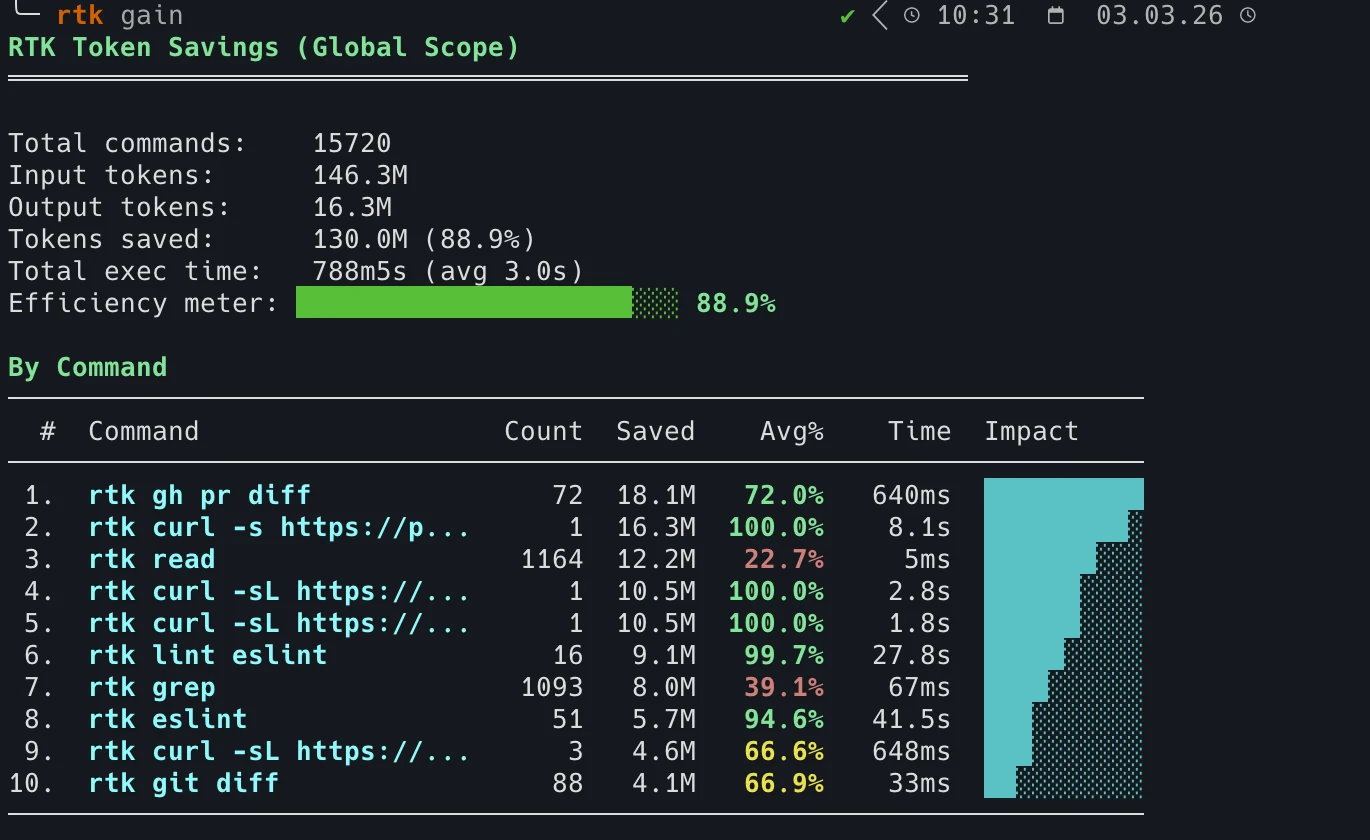
Tras unas semanas de uso diario: 15.720 comandos procesados, 130 M de tokens ahorrados.
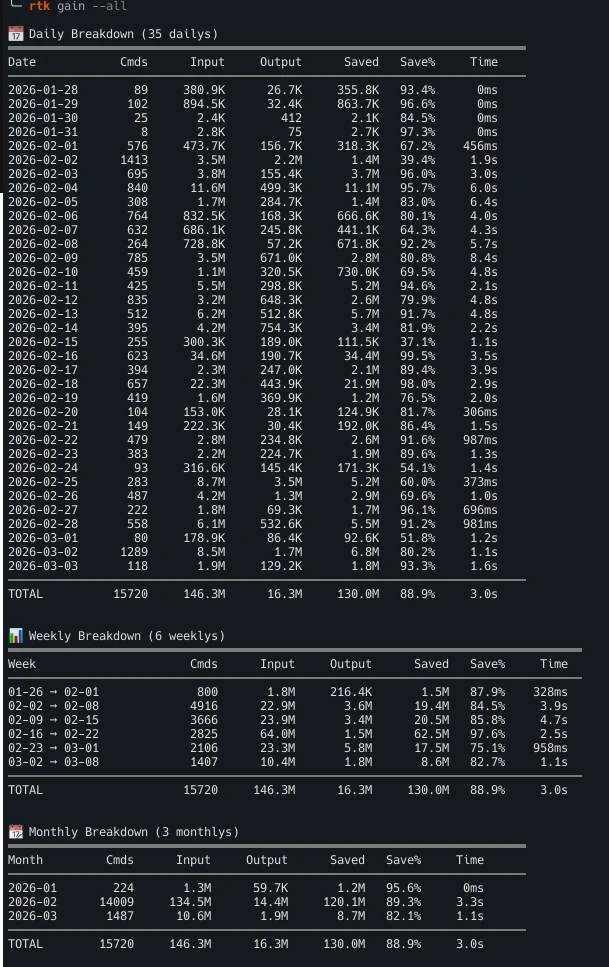
Estadísticas diarias, semanales y mensuales por comando. Ejecuta rtk gain para ver las tuyas.
#show-your-gains en Discord 05 / El impacto
Más eficiencia
Menos ruido. Contexto más útil. Menos tokens.
Menos ruido
Ventana de contexto más limpia.
Mejor razonamiento
Al agente llega información más relevante.
Menos tokens
Menos salida innecesaria entra en el contexto.
Compatible con tu stack de IA
- Claude Code
- Cursor
- GitHub Copilot
- Codex
- Gemini CLI
- Windsurf
- Cline
- OpenCode
06 / Empezar
Funcionando en 30 segundos
Instala, activa el hook y cada comando se comprime automáticamente.
Instalación rápida
Una línea para Linux y macOS.
$ curl -fsSL https://raw.githubusercontent.com/rtk-ai/rtk/refs/heads/master/install.sh | sh Homebrew
macOS y Linux.
$ brew install rtk-ai/tap/rtk $ brew upgrade rtk-ai/tap/rtk Luego activa el hook de reescritura automática
$ rtk init --global Instala un hook PreToolUse en settings.json de Claude Code: cada llamada Bash se reescribe automáticamente.
Guía completa →$ rtk init --global --agent cursor Configura el .cursorrules de Cursor para pasar los comandos Bash por rtk.
Guía completa →$ rtk init --global --agent <name> Instala un hook global de shell: funciona con Aider, Gemini CLI, Codex, Windsurf y cualquier herramienta de IA en terminal.
Guía completa →Preguntas
Las más frecuentes
What is RTK (Rust Token Killer)?
RTK is an open-source CLI tool that compresses command outputs before they reach the AI context window. It cuts up to 90% of that output noise with zero configuration changes, which leaves more of the context window for reasoning and lowers the token cost of every command that runs. RTK is written in Rust, Apache 2.0 licensed, and works transparently with Claude Code, Cursor, and any terminal-based AI assistant.
How many tokens does RTK actually save?
On the commands RTK rewrites, output drops by 56% on average, and by up to 90% on the noisiest ones. Across the community that adds up to billions of tokens saved. The exact figure depends on the command, so the benchmarks page publishes the methodology and the per-command results, and the blog covers what independent studies measured, including the cases where RTK did not come out ahead. For your own numbers, run rtk gain after a few days of use.
Is RTK free? Are there usage limits?
RTK is completely free. It is open source under the Apache 2.0 license, with source code available on GitHub at github.com/rtk-ai/rtk. There are no usage limits, no API keys required and no accounts. Telemetry is opt-in: it is off until you explicitly enable it, and it collects no personal data. For teams, RTK Pro is available at pro.rtk-ai.app.
Which AI coding tools and commands does RTK support?
RTK works with Claude Code (Anthropic), Cursor, Gemini CLI, Aider, and any AI assistant that reads terminal output. It supports all major CLI commands: cargo test, pytest, go test, git diff, git status, git log, grep, find, ls, pnpm list, tsc, eslint, prisma, docker, kubectl, and more.
How does RTK work without changing my workflow?
Running rtk init --global installs a PreToolUse hook in Claude Code that automatically rewrites Bash commands to rtk equivalents at the proxy layer. You continue using your normal commands. RTK intercepts and compresses the output before it enters the context window, with no manual changes to prompts or workflows needed.
Does RTK affect code quality or AI reasoning accuracy?
No. RTK removes verbose boilerplate and repetitive output noise, not meaningful content. Test failures, error messages, diffs, and stack traces are preserved in full. The AI receives the same essential information with far less noise around it, which leaves more of the context window for reasoning.
RTK Pro
La capa de control de IA para tu equipo
RTK se ejecuta en la máquina de cada desarrollador. RTK Pro conecta esas máquinas en una única capa de control e incorpora a todo el equipo: analítica de costos, barreras de seguridad y gobernanza.
-
Observabilidad
Análisis detallado en todo el equipo: uso y costo por proyecto y por desarrollador. Descubre qué cuesta de verdad y define métricas reales de eficiencia de tokens.
-
Seguridad
Cada desarrollador que incorporas llega detrás de barreras de seguridad: fugas de secretos bloqueadas, acciones peligrosas detenidas, datos sensibles anonimizados.
-
Gobernanza
RBAC, ACL y gestión de proyectos con granularidad fina. Un nuevo miembro se conecta una vez y llega listo: compresión, barreras, observabilidad, skills, MCP.
El CLI sigue siendo gratuito y de código abierto.